Showing posts with label Moses. Show all posts

Wednesday, November 18, 2020

Writing with White Fire


by Susan Weinberg

When you think of breakage and the Torah, one of the first images that may come to mind is that of Moses flinging the Tablets of the Law to the ground in both despair and anger. Below him were the Israelites, dancing around a golden calf. 

Rembrandt 1659
Moses Breaking the Tablets of the Law
Our lab discussion (handout-Searching the White Space) centered around two passages, Exodus 32:1-19 and Deuteronomy 10: 1-5. Exodus tells the story of Moses going up the mountain to converse with God for forty days. In the meantime, the Israelites become impatient and assume Moses will not return. They gather their gold jewelry to melt down to create an idol,  a golden calf. God observes what transpires and in his anger threatens to destroy the people, but Moses dissuades him, giving new meaning to speaking truth to power. Even better, he was heard and altered the path of potential destruction. Later in Deuteronomy, Moses recounts the steps God then required of him to create a second set of tablets.


In the Talmudic tradition we began with a question, a conundrum of sorts. Moses pleaded with God to still his anger and not destroy the people, yet when Moses came down the mountain to discover the golden calf, he too gave way to anger, flinging the tablets to the ground and breaking them into shards.


We distinguished between destruction and the passion of anger. Anger can be softened while we may not be able to come back from total destruction. Not all breakage is fixable, but anger may allow for a redo, in fact that is what was granted to both Moses and the Israelites.


We moved our attention to a midrash that spoke of the Torah being written in black fire on white fire. It is not just ink on parchment. It is alive and vivid. And that white fire is just as important as the black fire. It is the negative space, what is not spoken, but is created in relation to what is said. As artists we know that concept well in a visual way. It is the subject of much midrash, looking for the story within the story, the unspoken underlying content. It begins with curiosity, with a question and looks carefully at both what is written and what is not. Often the conclusion is evaluated through a metaphoric lens.


It is not coincidental that this process closely resembles the creative process. We are creating visual midrash through our artwork as we explore these topics. We too, begin with a question and our artwork explores the space around the text, the nooks and crannies that frame that black fire.


One of the questions posed was what happened to the shards of the tablets. In Judaism we bury or preserve and store damaged texts that contain the name of God.  It seemed unlikely that Moses left those shards at the foot of Mount Sinai. This was a question which also occupied the rabbis. Rabbi Meir read between the lines of “there was nothing in the Ark except the two tablets of stone which Moses put there” and concluded that it also included the broken pieces of the first set of tablets. They too were sacred in whatever form.


So, what does this all mean for us metaphorically? 


We bring our brokenness along with us as we move forward to wholeness. They are not discrete states, wholeness incorporates brokenness. We build on it as we find our way to wholeness.


Sometimes we can’t replace what is broken, a good reason to respect the fragility of what we value.


We may find that chipped Seder plate with a rich story more valuable for its very brokenness, its near brush with loss.


Perhaps brokenness is a necessary step that must occur to find wholeness. It is in our brokenness that we learn compassion, perhaps something Moses learned from  his own struggle with speech. And quite unexpectedly, at that critical moment he offered that teaching to God, in their own partnership, their hevruta, turning him away from destruction.  


And yet wholeness is not a static state, nor is brokenness. Moses continued to struggle with brokenness, literally breaking all the commandments into shards. He too was given the opportunity to rebuild into a new wholeness. 


We closed our discussion with a visual midrash, a look at the work of Yaron Bob who took the phrase "swords to ploughshares" to heart, repurposing brokenness to wholeness by turning bombs into menorahs and roses. 


A Rose of Her Own by Yaron Bob


A few additional art connections and more on Rembrandt's painting and Yaron Bob . . .


Rembrandt’s painting of Moses breaking the tablets.

Virtual  and Visual Midrash

Raiders of the Lost Ark could be considered a very long midrash about what happened to the Ark of the Covenant

Creative approaches to broken objects

A visual of what it takes to put together an archeological find

Mend Piece by Yoko Ono  creative approaches to broken objects

Rockets into Roses:  Yaron Bob.


Tuesday, June 14, 2016

Coming Down the Mountain

June 14, 2016 by Susan Weinberg 

We just concluded Shavuot, the holiday that celebrates the giving of the Ten Commandments. Moses went to the mountain top and came down with his face radiant as he clasp those two tablets to his breast, so radiant in fact that others were afraid to approach him.

 Often we see artwork reflecting Moses with horns, a rather puzzling interpretation. In fact it represents a translation error. Rashbam speaks of the radiance of Moses' face as representing "a brilliant light which gives off rays on every side". The word for rays is "karan" which is similar to the word "keren" which means horns. (see handout-Moses Radiance)

"So what makes someone glow?" asked the rabbi.

"Menopause" injected one of our group in humor.   Feeling a connection, when someone is in their element and passionate about something added others. What else makes us glow? Humor, enthusiasm, love, confidence and assurance were offered up.

"So why was Moses shining?" asked the rabbi.

Here we dug a little deeper. Transmission of energy, infused with the light of Torah. Some focused on Moses as conduit between God and the people, you plug in the socket and it glows. The rabbi suggested that some believe the light was coming from the tablets and was reflected light.

 "So why does the face shine and not some other part of the body?"

Our eyes are the window to the soul offered some.  Our eyes are how we make a connection with another person.  Proverbs 20:27 elaborates on that connection when it says  "the spirit of man is the lamp of the Lord".

"Do we know of anyone who shines?"

Martin Luther King Jr. and the Dali Lama were offered as examples.

We then shifted to a few parables.

We considered a story of Rabbi Abbahu who was believed to have found a treasure because his face was glowing.  When questioned by Rabbi Yochanan as to whether he had heard a new interpretation of Torah he referenced an ancient source that he had discovered.  Rabbi Yochanan noted "A man's wisdom makes his face shine". Wisdom can come from both old and new. (handout-Coming Down the Mountain)

From the Hasidic Parable by Aryeh Wineman we discover Sadness in Finding a Treasure.  The story involves a man discovering a treasure too immense to count and he lacks the containers to take the full extent of the treasure.  He is distressed by what he must leave behind.  What does this mean?

There is too much to fill up the small containers that we are.  Take what is essential.  Don't be arrogant, always leave much behind.  David considered whether we needed to view it from a different perspective and shared with us a story from Jean Cocteau who was asked if his house was on fire, what would he carry out of it.  "The fire", he replied.

The rabbi closed with the question, "What are we taking with us and what do we leave behind as we close out this year of the lab? "

 I'm a "top of the stairs responder".  You know, the kind of person who comes up with her response as she is leaving the room and the topic has changed.  It works fine for writing a blog, but less so in the moment.  So after some thought here is what I take and leave.

I take with me the community of friends I have made through the lab, the ideas and discussions that enrich my artwork, my knowledge that has deepened about Judaism and the many things I have learned from others in the group and our wonderful facilitators.  What I leave behind is a little harder.  When I first entered this group, I carried some unease which I now leave behind.  I felt outside of the community and as a more secular Jew, I wondered if this would be a comfortable place for me. I have found it to be a very embracing community and close the year feeling that this is in fact my community and I am very pleased to be a part of it.


A Still Small Voice

In the second part of the lab we were led by Rabbi Debra Rappaport of Shir Tikvah in a discussion about wisdom and silence.  She began by speaking of the relationship of wisdom to Kaballah. Wisdom is one of the Sephirot, the ten attributes of Kaballah.  It is the seed of a thought. By the time we have created an artwork it has gone through many phases. The root of wisdom is in the potentiality.

We shifted to the subject of silence and its relationship to wisdom.  In the Mishnah Rabbi Shimon ben Gamliel speaks of silence as beneficial for the body.  Rabbi Akiva describes it as the fence for wisdom.  The Talmud speaks of spending an hour in meditation as a preparation for prayer. (handout-Wisdom-Presence)

In keeping with the subject of silence, Rabbi Rapport asked us to write about what silence was to us.

As one who embraces silence, I loved this topic and wrote:

"Silence is like a warm bath.  It surrounds me, supports me, uplifts me, but doesn't impinge on me.  I float in its embrace.  it calms me and opens me.  Unexpected thoughts and ideas grow within it."

I related the story of how my husband and I deal with silence in different ways.  He enjoys music and often assumes that if I am in a room silently that it is an invitation to turn on music.  I've taken to playing classical music, my fallback to silence,  to let him know the aural space is occupied. For me silence is a presence, not an absence.  Music, particularly with words, is a distraction from my thoughts. Usually I create in silence.

Others who defined themselves as introverts noted their need for silence and spoke of it as a gift.  Still others offered that silence allows time for the creative process to breath.  Silence is the voice of the unspoken.  Not everything is voiced in language. Some noted that they needed silence for certain parts of the creative process and certain types of music for other parts.

As we closed this discussion the rabbi pointed us to Kings 19:4-12 where Elijah waits through wind, earthquake and fire for the Lord to make his presence known.  When all the pyrotechnics have passed there is a still small voice that emerges.

Thursday, February 27, 2014

A Glowing Visage

Our recent Artists' Lab began with the question, "Why do people sometimes glow?" That of course led to the often expressed reference to pregnant women glowing. One of our group posited that perhaps that glow is fueled by the addition of the baby's energy. Hmm, glowing for two. Our discussion soon led into auras and chakras.


Rabbi Davis directed us to the text of Exodus 34:29-35 which speaks of Moses' descent from Mt Sinai. This passage talks about how Moses' face became radiant after speaking to God and put forth light. The Midrashim, the sages' interpretive stories on Biblical text, offer several interpretations of this event. One theory was that when Moses took the second set of tablets from God he was only two-hand breadths away and acquired the glow because of this proximity. Yet another theory was that Moses acquired the glow when God taught him Torah. Yet a third theory was that he was born with this shining visage. The light was described as so bright that he lit up a house and one could see from one end of the world to the other.

These rays of light, in Hebrew "keren-or", account for the sculpture of Moses by Michelangelo for in addition to "rays", the word "keren" also means "horn". As a result Moses is often depicted with horns, rather than rays of light as indicated in the text.

The Israelites were initially afraid to approach Moses because of his radiance. When he finished speaking with them he covered his face with a veil or hood. I wondered if this was ever depicted in artwork, but a quick search displayed the familiar bearded visage, occasionally with horns, but no hood or veil. We discussed this separation between the divine and the everyday, a division echoed in the separation of Shabbos from every day. Similarly the Aron Hakodesh, the ark which houses the Torah, is also covered, creating a special moment upon its removal. In the case of Moses it was proposed that he employed the veil so as not to confuse the message with the messenger. He was representing himself as a vessel for God.

We turned our attention to the Zera Kodesh authored by Rabbi Naftali Tzvi Horowitz (1760-1827). We are told we should hold God before us at all times recognizing a divine light surrounding each of us. Horowitz looks to the letter aleph which represents the name of God and notes that it evokes the name of God linked to mankind in a surprising way, it echoes the form of our face. If we break it down to its component parts we see two yuds and a vav, two eyes and a nose, figuratively holding God before us in our own face.

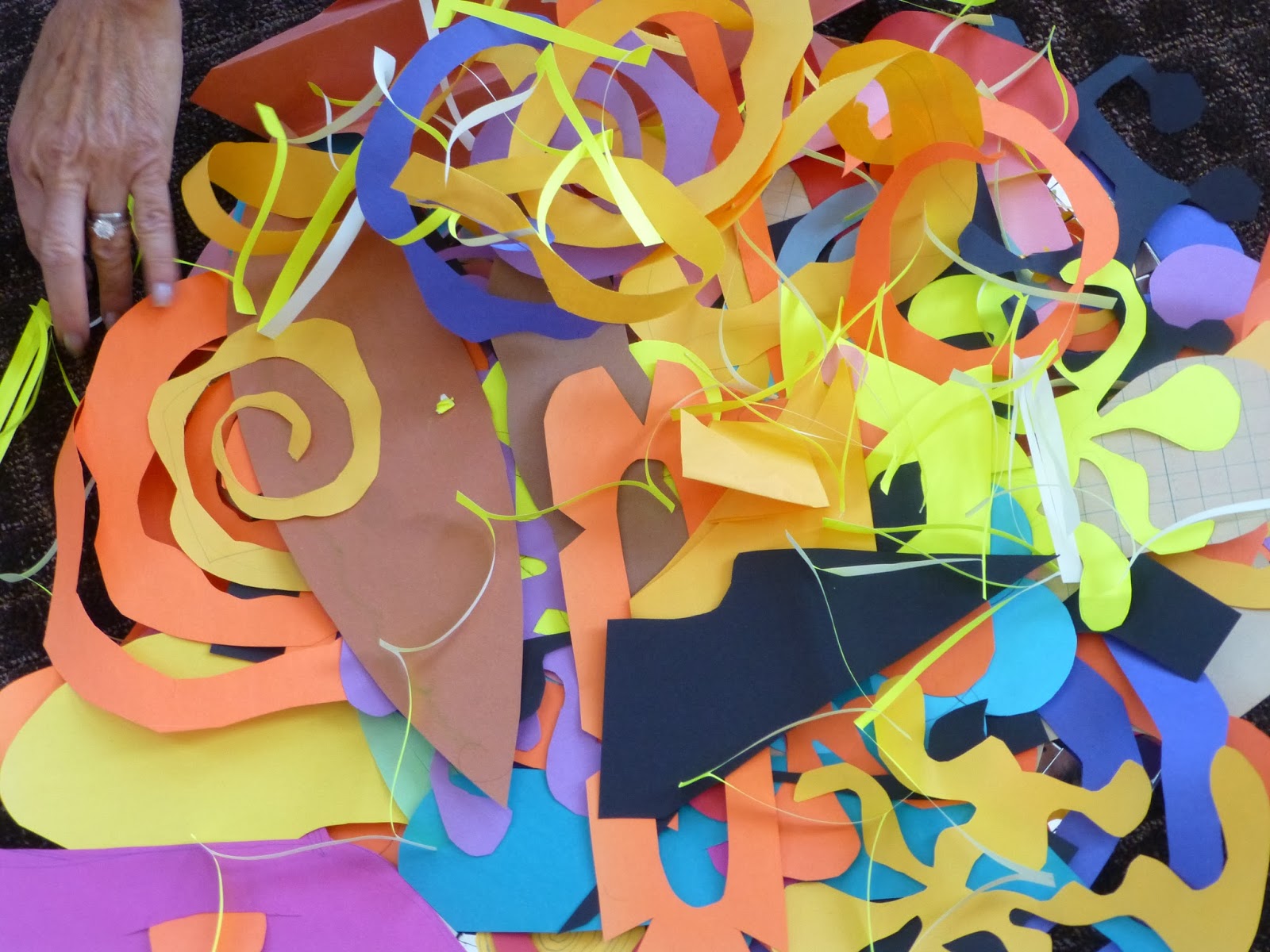
For the arts portion of our session Avi and Robyn led us in the creation of a group mandala. We talked of sacred space and the mandala with its circular form as a meditative vehicle. Each person selected five sheets of colored paper in colors we preferred. We were then charged with cutting out five forms which could be the same or different. Our choice was to be influenced by three questions: 1) what shape or color represents our creative process? 2) what is the inner core, the image that reflects our inner self? and 3) what are the layers, the rings that build us?

My paintings are based on story and often arise out of a process of inquiry. I listen and then create, building imagery on layers of discarded attempts. My result was an ear-like form with open areas exposing the underlying layers. We adjourned to a circular room where a round mirror created the center of the mandala. First a perimeter was formed, then Hebrew letters were placed in the center ring, both the cutout and the negative space created by the cut form. Those with larger shapes placed them first, then we each placed our forms so that they interacted with each other's. Many of the cutouts expressed a meandering shape, reflective of the typical creative process while also hinting at  the influence of the recently opened Matisse show.


 Slowly we watched the mandala take shape, forming a beautiful structure that reflected a diverse and creative group.  Even as we contemplated this beautiful expression, we knew that the nature of a mandala is transitory.


We gathered the pieces together with a  plan  to shred them and perhaps recycle them to an alternate purpose.


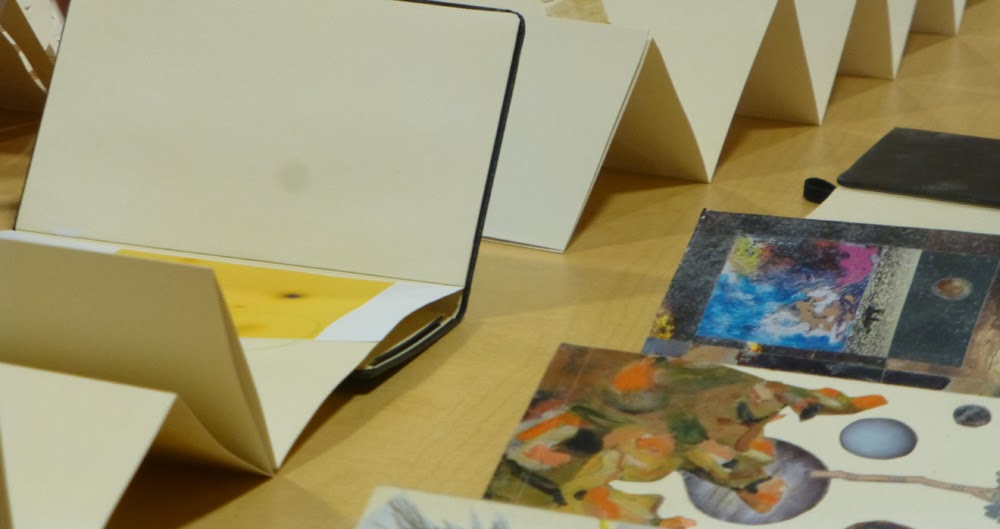
We closed our session with a sneak preview of the first stage of our sketchbook project, soon to be sent to our sister labs in Milwaukee and Madison. Here are just a few of the creations of our multi-talented group.