Showing posts with label Water. Show all posts

Wednesday, December 18, 2019

Creative Destruction

by Susan Weinberg
We gathered tonight in a special Artists’ Lab done in conjunction with eighth-graders from Talmud Torah and led by facilitators from the In(heir)itance Project. The in(heir)itance Project last joined us in 2015 and performed a play that many in our lab attended. Their approach is to engage the community in dialogue and then use that dialogue in the creation of theater. Their theme on this visit is water. A return visit will be made in February in hopes that the seeds that were sowed through this visit might take root.

Teacher Kara Rosenwald and the eighth-grade students came together with a number of lab members in this exploration. Chantal and Ari from the In(heir)itance Project led us through an exercise of creating a word cloud around water. As they went around the room, each person offered up a word that they associated with water. 

Body, Source, Quench, Fluid, Lake, Silk, Trees, A Right, Rising, Flow, Hydration, Health, Clear, Ocean, Drink, Cloud, Wet, Dogs, Rain, Ice, H2O, Turtles, Survival, Ripple, Tea, Waves, Gills, Flood, Memory, Access, Precipitation, Evaporation, Runoff, Filtration, Wash, Fracking, Thirsty, River, Land, Light, Rift, Fish, Shark, Salt, Swamp, Pollution, Waste (water), Glacier, Iceberg, Mayim, Plastic, Reflection, Mermaids, Play, Sea, Well. . .

We began to find the common themes within the words. There were elements of water – fluid, wet, reflective. The forms or characteristics that it might take- ice, steam, rain and then there were the ways we interact with it. Many of the words represented consumers of water, including us as our body is 70% water. Another large consumer, trees.  A thirsty cottonwood tree can consume 200 gallons of water each day.
 “Where does water come from? “ they asked and drew our attention to the first story of creation in Genesis. There the first mention of water is in the second line of the Torah. Remember Ruach? the spirit or breath of God that hovered over the water. While we often think of God anthropomorphically, here the water is given a face as well.  Is it God’s face, reflected within the water?

1 In the beginning God created the heaven and the earth. 2 Now the earth was unformed and void, and darkness was upon the face of the deep; and the spirit of God hovered over the face of the waters. 

So, was water primordial?  It seemed to always be there. Nowhere does it speak of its creation. We discussed its presence as elemental, a core element in all things and for God on the second day, a creative element. Just add water. Or perhaps just divide water into firmaments and ocean. Water is both a creative element and a destructive element. Often those two acts are related. Water carved out the Grand Canyon, destroying in order to create that negative space that evokes such wonder. 

Now that our wheels were well lubricated, we broke into groups to choose a descriptor and develop it into an artistic creation. The theme of our group was the cycle of both creation and destruction, often flip sides of each other. The eighth graders led the way without hesitation, drawing a wave and then another wave in reverse echoing the form. We used blue to represent creativity and grey tones to represent destruction. While our image came together in the last five minutes it was a satisfying creation that captured the contrary, yet complementary nature of our subject. 

Friday, August 28, 2015

Flowing In, Flowing Out

Joint Lab -August 27, 2015 by Susan Weinberg
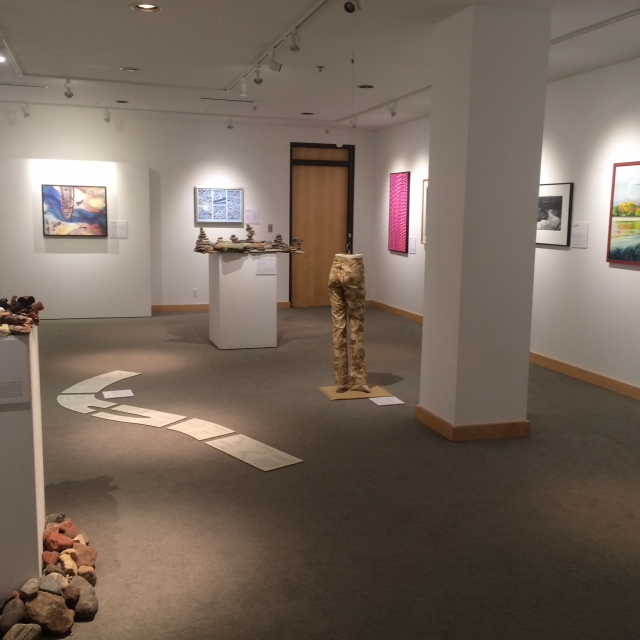
Last night was closing day for the third Artists' Lab exhibition. We gathered in the gallery and each of us shared with our fellow artists the process behind our work.
I always feel like an apology is necessary when I attempt a recap as I can't capture all of the artists' work in the space of a blog post, particularly as the number of artists grows. I shall leave it to the catalog to do that. With apologies to those I missed, here is but a sampling to reflect the efforts of the year 3 lab artists.

Outside of the gallery we were greeted with three images. Ann Ginsburgh Hofkin shared her photograph of a wave on aluminum. Frozen in the moment, it evokes that moment when the Red Sea parted for the Israelites.

Next to it Jonathan Gross presented us with a highly detailed panoramic image of the river. It was so rich with story that I found myself imagining using it in a classroom as the impetus for students to construct narratives. On the far left he captured a group of kayakers, a serendipitous event that his process allowed him to replace within the panorama. On his right you can see a painting by Sandra Felemovicius that seeks to capture reflections within the water.

That was our warm-up. Now we entered the gallery. One of the things that I especially liked about this show were the interactions between artwork. Often it seemed to me that they were having conversations. Let's listen in...

Joel Carter's rock sculpture seemed to be working the room, creating interesting vantage points in relation to other works. Joel realized that his well-polished river rocks that he uses in his carefully balanced sculptures come from... water! 

 Below (left) you can see his work chatting up Rani Halpern's layered, dyed and cut image that is based on a midrash of God dividing the waters into sky and ocean. When those below protested their perceived lower status, God took his finger and tore the waters apart. The warm colors of the rocks also frame Susan Armington's Waters of Babylon (right). the land of exile for the Jews and the modern day Iraq.

Near Susan's work you can see Sylvia Horwitz's amazingly Biblical photograph of a tumultuous sky over still waters, the firmament in-between.
Alison Morse's words trace the form of an Italian river on the floor below, even as they tell the tale of an Italian Jew. But it does more than that, it guides us in and out of the gallery, directing us along the river to the artwork that surrounds it.

Susan Weinberg's diptych on water and memory conversed with Bonnie Heller's reminder of the two worlds between which we can choose. Several people jotted memories that they had shared with those who lost memory for the memory jar that sits before the paintings.


The shape and concept of the tear or raindrop was echoed in both Leah Golberstein's sculpture of stones and salt, Liba Zweigbaum Herman's water ketubah and Rani Halpern's chain of rain drops. Leah's work is based on a midrash about how God offered Adam and Eve the "tear" as a release and solace upon their exit from Eden. Liba invites each of us to pledge our commitment to managing our water resources, all framed in the form of a ketubah, a contract with our guest of honor - water.

Many of the artists talked of how the lab had encouraged them to try new mediums or approaches. Rani spoke of how the layered approaches in her work were new to her since the lab. Notice above how the shadows on the wall in her work add yet another layer to her multi-layered work. Sylvia referenced her more typical work of documentary photos versus the work she has produced in the lab. There have also been some collaborations. Sylvia Horwitz and Susan Armington collaborated on a show this year while Louise Ribnick and Diane Pecoraro collaborated on their lab exhibit - artwork and a prose poem around the theme of seltzer (below).


The approaches were unique and varied and most certainly creative. Jodi Rosen (above right) laminated text and placed it in water, then stirred it as she photographed it. 

Judy Snitzer (left) combined paint, collage, wood and text describing our relationship to water from Eden forward. And like several of us she built upwards. The more artists we have the less horizontal space is available and so we build our skyscrapers of art.

And as I can't capture everyone's work, here are some quick views of the gallery before we sadly dismantled it.
Finally that bittersweet moment when we removed our work from the gallery arrived.


Thursday, June 25, 2015

Ending on High Tides


Joint Lab 6/23/15 by Robyn Awend
Water has been our source of inspiration for the past year. It has quenched our thirst for knowledge, satiated personal and artistic growth, and created fluid connections with others.

Tuesday was our last Lab of the season. We gathered in our large group of nearly 30 and began with a nigun (song) about water, as we often do.  Rabbi Davis introduced Proverb 27:19: “As in water the face to the face, so the heart of man to the man.” We analyzed the Hebrew and English versions, discussing what this could mean. The group responded, “Water takes the shape of its vessel, as does the heart.” “Water is the connecting link to all things, as the heart connects us to one another.” “We can see our self in water's reflection, as we can reflect love onto our self.”For further discussion, Rabbi Davis & Meryll went on to share several thoughts from various sources about its meaning (from King James, JPS, A. Bible, ISV, etc.).

He then raised the question, “How does your artwork reflect who you are?” It was silent for a while as contemplation set i. Slowly, we went around and shared our thoughts –for some it was about our personal work serving as a direct reflection of who we are…..or the essence of the individual….or a product of where we are and where we want to be.

The follow up question was raised, “Has your experience with the Lab allowed you to connect with another person in the Lab in a significant way?” Two people sitting next to each other immediately hugged, two others caught eyes and smiled, and another raised her hand and shared about her connection to community.

We were then invited to stand together in silence. We were guided to flow like water, and at the sound of the bell, stopping and facing the person next to us while exchanging a moment of silence, together.  This lasted several rounds, there were hugs exchanged, smiles shared and even tears shed. We then gathered hands and danced and sang shuv-tey-mayim.
After a short break Liba and Yoni introduced us to a collaborative initiative that each of us would contribute to –a water symphony.  Juxtaposed to our recent exercise in silence, we now gathered around a series of tables to create sounds with interesting vessels filled with water (wine glasses, tubs, containers, etc.) and a slew of sound making gadgets (bath toys, sponges, straws, ladles, etc.).  We were each asked to choose one gadget and one vessel with which to create a sound. In complete silence, one by one, we began to create our individual water sounds, adding to the collaborative symphony.  As Liba tapped our shoulders, it was our turn to stop and just listen as the symphony faded to one last sound of water being squeeze from a sponge into a large pan. Yoni recorded this symphony, along with everyone else who had a recording device. We were exhilarated to be part of this two+ minutes of art in the making. Click here to hear our result.

The last exercise of the day was to create and record a unique breath, different than the person before you. We went around in a circle and shared our breath, some calm, others rapid, a few mysterious….

We closed the Lab by offering any last comments or shared thoughts. The room was overflowing with gratitude and a feeling of completeness.


Wednesday, June 17, 2015

Into the Mikvah's Waters

6/16/2015. Lab 2.0 by Paula Pergament

Lab 2.0 came to a close at Paula Pergament's lakeside home, a fitting conclusion for our theme of water.

Water and stone.

We each took one hand-sized rock from a pile of rocks Joel Carter contributed...We sat on the dock right over the water...contemplating thoughts ...holding our chosen stone.

Joel shared a poem about water.
The rest of us spoke a thought,
a word, a wish, a dream,
a trouble, a pain...
and each of us gave our words and stones 'into the mikvah's water'...

Rani's father's yahrzeit was last night and she chose to honor his memory by placing a stone gently into the lake...

Diane passionately shouted & with gleeful energy threw her rock far into the water.

It began to rain, so we headed inside to finish our lab inside at the kitchen table.  Wrapping rocks with beautiful Japanese rice papers, that represented water in color or by design, & twine.

Chatting about previous art labs, ideas for next year's lab, & eating 'water'melon, pecan'sandies' and chocolate ( not water related ...
but necessary).

A casual ambiance sat gently at the table with us.

Thursday, June 11, 2015

The Rivers of Babylon


June 9, 2015 Lab 1.0 by Meryll Page

 Is water a memory trigger for you?  That was the discussion question for Lab 1.0 during the June 9th session.  We analyzed Psalm 137—“By the waters of Babylon, There we sat and we wept as we remembered Tzion.”  As opposed to our personal experiences remembering by a body of water, this psalm is a collective memory that preserves the profound sadness and anger of the Israelite exiles post 586 BCE. The harsh ending of the psalm led to an emotional discussion of art as a process of confronting sadness and anger in our own lives. 

Liba continued Meryll’s text lesson with an invitation to the participants to write about memories of a specific body of water.  One word of those memories was transferred to paper to add to Camille Gage’s work, I am Water—an interactive public artwork that challenges viewers to consider their relationship to the Earth’s water resources.  All contributed to the river of images and words begun in the previous lab which will be part of our exhibit.

Rewriting History

Sharon Zweigbaum's talk on public art gave many of us food for thought. I especially enjoyed Meryll Page's contemplation of public art as a vehicle in Russia for rewriting history.  You can find her blog at Absurdist Sculpture-Russian Style

Tuesday, May 26, 2015

Going Public


May 26, 2015 Joint Lab by Susan Weinberg

Today seemed especially suited for the Artists' Lab given our topic of water.  We sloshed our way through torrents of rain to gather for Sharon Zweigbaum's inside perspective on public art.  Sharon is a long-time art aficianado with a MA in Art History and Museum Studies.  She has served as an arts administrator, a writer, a long-time Walker docent and runs tours of topics related to public art for her business Artvantage.

Sharon began her presentation by asking what we knew of early public art in Minneapolis.  We concluded that much of it was commemorative art honoring a specific person.  One non-person specific piece that has been around since 1904 is the Father of Waters in city hall.  Originally created for New Orleans at the other end of the river, it was deemed too expensive and instead made its way further up the Mississippi to Minneapolis.  It contains many symbols of the river and was created by Larkin Mead.

It was not until the 1980s that the Minneapolis Arts Commission was created and focused upon art in public places, bringing a more contemporary perspective to public art.  They commissioned over 50 artworks.

Sharon shared a bit of history with us emphasizing how many of the names within Minnesota relate to water.  Mississippi is an Indian word misi-ziibi meaning Great River.  It is 2320 miles long from the headwaters to the mouth and the 4th largest river in the world.  Minnesota means sky tinted water, Minnetonka- the big water, Mendota - meeting of the rivers and Minneapolis means city of lakes.  There are 22 lakes and wetlands within Minneapolis alone and over 12,000 in the state of Minnesota.

St. Anthony Falls is the only true falls on the Mississippi River.  Father Hennepin was the first European to see and write about the falls. He had been captured by Indians and lived with them for two years.  During that time he first saw the falls, nearly 60 feet high, in the area that is now Minneapolis.  In their travels they encountered French explorer Daniel Graysolon Du Luht ( the source of the name for Duluth, MN) who persuaded the Indians to release Hennepin. There is a statue of Hennepin in front of the Basilica today.

Native groups had many words for the falls some of which translated to curling water, falling water, whirlpool and severed rock. The power of the falls was later instrumental in Minneapolis becoming the milling capital of the world in the 1880s.

Sharon then took us on a visual tour of many of the public art sites in Minneapolis beginning with  the Mill Ruins Park and the Gold Medal Park that overlook the Stone Arch Bridge.   She noted that the Stone Arch Bridge was built by James J Hill in 1883. 

There are a number of public artworks in the city and many of them relate to water.  Some of the ones that Sharon highlighted can be found on MPR Soundpoint where you can dial a number and hear the artist speak.  The Tilted Bowl Fountain by Seitu Jones forces one to hold the bowl like a kind of ritual or homage. The piece is designed to recall a shell of a mussel which is endangered as well as water pouring out of the bowl. 

Another sculpture Enjoyment of Nature is by Kinji Akagawa and located across the street from the downtown library.  The work looks at the metaphor of how the city grows similar to the circle that forms when a stone is thrown into water.  The piece was taken down at one point due to damage from skateboarders, but is now back in place.

Some of the challenges to public art in addition to skateboards include new construction, vandalism and barriers that have been created since 9-11.

Many of the public artworks can be found on a map put out by the Art in Public Places program in 2002.  While some pieces may have been retired and new ones added, the map highlights a number of the pieces that Sharon addressed.  Those include George Morrison's piece on Nicollet Mall called
Tableau Native American Mosaic.  Morrison focused much of his work on Lake Superior so a connection to water is found in much of his design.

In 1992 Seitu Jones and Tacoumba-Aiken together with poet Soyini Guyton created Shadows of Spirit.  These  bronze shadows were of minority members who made significant contributions to the community, but were not adequately recognized.

Also included were the frescos of St. Thomas by Mark Balma, the second largest ceiling fresco in the US. The frescos include the theme of the Mississippi River representing the flow of life.

A number of the pieces can be found on-line.  Among those are  manhole covers by Kate Burke that reflect themes related to Minnesota. 

More recent works were created when the central library was developed. The terrazzo floor by Lita Albequerque in the library commons is based on what happens when one skips a stone across a body of water. 

A cast glass sculpture by Howard Ben Tre can be found by Target Corporate Headquarters on Nicollet Mall.

A survey of public art related to water would not be complete without a trip to the Walker where we find Frank Gehry's giant fish perched over a pond.  This fifty-two foot tall glass sculpture was created for the 1986 Gehry retrospective and then taken apart scale by scale until it was reassembled.   Gehry was originally Frank Goldberg and recalled the fish swimming in the bathtub prior to their demise to make gefilte fish.  Fish are a motif that he often uses in his work.

Also at the Walker one will find the Claes Oldenburg and Coosje van Bruggen Spoonbridge and Cherry.  The spoon and cherry are in a pond and serve as a fountain.  His wife Coosje felt that the spoon would be too dull in the winter and added the cherry for color.

There are many more pieces than can be covered adequately.  I invite you to reference a more recent map  put out by Forecast to find additional works.

We concluded our lab with some hands-on work on the river.  On a long sheet of paper we drew a river and then using watercolor and drawing pens added elements to it, flowers and fauna and birds and ducks and of course public art!

Tuesday, May 19, 2015

Meeting at the Well: Israeli Artists Examine Water

Lab 2.0 5/19/2015 by Susan WeinbergOur lab session today explored our theme of water as it relates to Israel and the ways in which Israeli art deals with this theme that is so central to Israeli life.

Phil Rosenbloom and Suzanne Fenton began the session with a quick view of artworks they had gathered by Israeli artists that relate to water. As they showed the image briefly we were to write one word that came to mind. That was our introduction to a variety of work to which we returned later in the session.

We then surveyed some of the leading artists who deal with themes of water. One of the most fascinating has to be Sigalit Landau. She views her work as a bridge maker and uses not only water as a medium, but salt, a central image of the Dead Sea. We viewed several videos of her work.

Salted Lake uses shoes as metaphor, shoes constructed of salt from the Dead Sea. These shoes are then placed on a frozen lake in Gdansk, Poland and through time-lapse photography she captures them as they melt and "drown" in the water. The sounds of the port change to a cold whistling wind as day turns to night and the shoes slowly sink. It reminded several of us of the Budapest memorial of shoes along the Danube.

Another work by Landau is titled Dead See and presents an aerial view of a raft of watermelons floating on the Dead Sea as they slowly unwind. In the midst is the naked body of the artist as she reaches to several watermelons that are sliced open, exposed as she is to the stinging salt.

In Mermaids she presents a video of three nude women on the border between Gaza and Israel scratching the sand as they are pulled back into the water. Slowly their woman-made created border disappears.

Other work that we viewed included Yaacov Agam's Fire and Water Fountain at Dizengoff Square and the Dale Chihuly sculpture of Fire and Water at the Aish HaTorah World Center at the Western Wall.

We examined water issues in Israel and the resolve to innovate to address the perennial shortage. The Sea of Galilee accounts for 30% of drinking waters supplemented by aquifers, reservoirs, groundwater and desalination plants. Groundwater comes from two main aquifers, the Coastal aquifer and the Mountain aquifer. Both lie under the Palestinian territory, in Gaza and the West Bank respectively. More than half of Israel's total natural water originates outside of its borders in Lebanon, Syria and the West Bank.

Alexander Kushnir, Head of the Water Authority spoke of the accomplishment that 80% of purified sewage goes back to agricultural use, far in excess of the 18% of Spain, the next most successful. Despite many successful innovations, Israel is still challenged when rainfall declines and desalination has become the focus, albeit a controversial one. Green organizations are concerned that more saline will be pumped back into the sea altering its composition.

We shifted our attention to how the well and climate has shaped Biblical history. Wells are a frequent image within the Bible. Hagar in the wilderness with her son Ishmael runs out of water and await death when God opens her eyes to a well before her (Genesis 21:19).

Joseph is thrown down a well by his jealous brothers (Genesis 37:12-36) and is ultimately rescued and goes on to become viceroy of Egypt.

Often the well is the place where the patriarchs met the matriarchs, happy hour at the watering hole. Rebekah and Isaac meet at the well (Genesis 24: 11-20) as do Jacob and Rachel (Genesis 29:2-10).

The concept of the well is celebrated through ritual. At Sukkot there is a water ritual known as the Rejoicing at the Place of the Water Drawing. The celebration, and it is truly a celebration with music, dance and juggling, is based on Isaiah's promise, " With joy shall you draw water out of the wells of salvation" (Isaiah 12:3)

We returned to the images that we viewed at the beginning and focused upon work by Avital Geva in the Greenhouse Project. His work with school-age children, both Jewish and Arab, is focused on building coexistence projects. They study recycling water combining science and art installations. We also viewed a video of Spencer Tunick's Nude Dead Sea shoot, designed to focus upon the theme of water in Israel. The video gave the sense of a social gathering as participants gradually grew comfortable with this massive skinny dip in the Dead Sea.

As we shared our one word describing each piece, we found that we filtered our reaction through our own experience, sometimes with widely diverging responses, other times quite similar.

We concluded our session with a photo shoot of sorts. Various vessels were provided containing water and we were invited to photograph them and send the photos to Phil who will take the images and compose them into a larger collage-like image of an oasis. Soon we were manipulating the water, pouring, spilling, splashing into images of fluidity.


Friday, May 8, 2015

Mayim, Mayim

May 8, 2015 by Susan Weinberg
Our Artists' Lab retreat began with a gathering at the All My Relations Gallery. We were fortunate to catch the show shortly before it came down as it tied closely to our topic of water. The show The Art of Indigenous Resistance: Inspiring the Protection of Mother Earth brought together work by twenty artists that examined the power of activism through art.

Graci Horne, the new director and curator of the gallery, talked of the Native American tradition of caring for Grandmother Earth. In this tradition water is very sacred. She recalled that when she was growing up she was told that some day there would be wars over water. She noted that where her tribe is located is the second largest aquifer in the US and there is fighting between those who want to drill. The drilling company seeks water rights while their opponents allege that drilling is likely to contaminate the water, the source of drinking water for the nearby cities. The focus of Native Americans is to unify people and remind them of their responsibility for the earth.

Camille Gage then spoke about her project I Am Water, an interactive public artwork that challenges people to consider their relationship to our planet's fresh water. Camille noted that 80-90% of marine pollution is plastic. Plastic beverage holders take 400 years to disintegrate.

Camille spoke to a number of threats to our water supply. Monsanto's Roundup, the number 1 selling weed killer was recently reported by the World Health Organization as a "probable carcinogen".

She spoke about the commodification of water and shared a quote from Nestle's Chairman Peter Brabeck-Letmathe in which he notes "water is the most valuable food stuff on the planet" as if it were made in a factory. She noted that it takes 1.5 gallons of water to make the plastic that holds the water. Nestle's benefits from this commodification of water, making $7B annually on global water sales.

More than two thirds of the Bakken oil fields production is shipped through Minnesota, over 23 million gallons daily. This highly flammable shipment has already caused serious explosions. 

Mining is declining on the Range and attention has begun to shift to creation of new jobs when mines are capped. Mining versus environmental protection remains a volatile subject. Camille called for reframing the discussion to have a dialogue that respects the historic contribution of miners even as we look at what it will be in the future.

She shared a number of artworks that deal with water including Bodies on Ice, Basin, the Overpass Light Brigade and Ananya Dance Theater. Camille also shared her experience as a water walker. A water walker walks a body of water and each step is a prayer. They carry a copper vessel of water and in presence and prayer make their statement.
We also have an opportunity to add our prayers for the water. Camille is doing a community art project that invites people to imagine a body of water they feel close to, write a prayer or wish for the water and paint an image on the other side. She is collecting these wishes/prayers in an installation that continues to grow.

We concluded our visit with an impromptu dance to the song Mayim Mayim. The words mean "With joy shall you draw water from the wells of deliverance". And one last group photo.
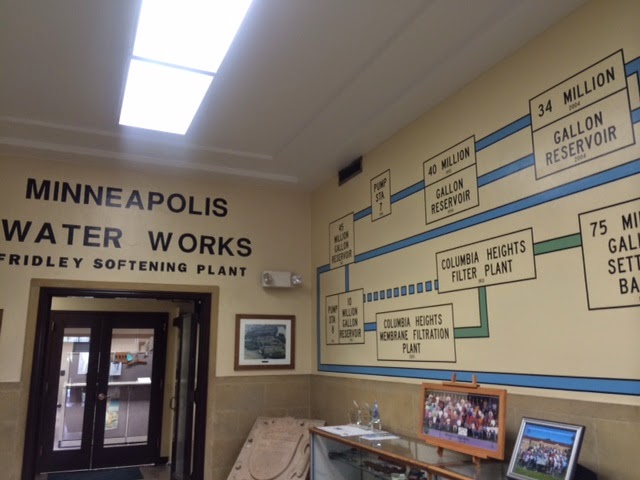
Fridley Softening Plant Wall Map
After savoring the renowned corn pancakes at Maria's Cafe, several of us traveled on to the second part of our retreat, a visit to the City of Minneapolis Public Water Works. A special thanks to Kris Prince who recommended this visit which proved to be a fascinating glimpse at the process behind the tap.

The buildings were actually spread across a campus that had been constructed over many years. The river ran alongside the buildings, a location that was of course critical to the function they performed.
In the lobby of the Fridley Softening Plant we met George, the Water Quality Plant Manager who took us on a tour of the facilities. A map was on the walls of the process and the locations where each process occurred. We were to learn that the color coding was significant with dark green representing untreated river water, light green- softened water, brown- the sludge that is taken out and blue-the drinkable water. We later were to learn that even some of the machines were color coded in a similar fashion.

George advised us that the plant serves 500K people and that 50M gallons a day were treated although capacity is 140M. Water usage has in fact fallen as people have begun to manage it more effectively.

Grates in Station 5 with River Below
River outside Station 5
The water goes through several processes to soften, filter and purify it. He noted that around 1910 people started dying from typhoid because of the water and they began to chlorinate it to purify it. Typhoid deaths fell to zero. The filters are .02microns and don't allow e-coli to get through. A human hair by contrast is about 100 microns. Two thirds of the water goes through Fridley with the balance going through Columbia Heights. There are built in redundancies so they are always pumping.

Station 5-sludge goes into green containers
We walked over to Station 5 where the river ran next to the building. George pointed out a sluice gate from 1920. The river water flows in below and was visible in the grates beneath our feet. It then goes through filters and the sludge is captured within green containers. Sludge is sold to farmers to put on their fields.
Pumping Room

After a visit to the Pumping Coordination Center we entered the Pumping Room. Here the green pumps represent river water going to the softening plant. The blue pumps represent clean water.
We returned to the Softening Plant and stepped into the basement. There giant pipes snaked across the building which had actually been constructed around the pipes.


Lime slakers
Minneapolis draws its water from the Mississippi River so has no water shortage. Water comes out of the river and runs back into it. Surrounding suburbs rely on groundwater which flows back into the river. Thus they are more challenged by potential water shortages. The MPCA has proposed that suburbs contract with the city or build their own plant to bring in river water.

Within the softening station we stopped by the area in which this occurs, the lime slakers. The room was dusted in white from the lime which plays an important role. Lime is added to soften the water. It then precipitates out of the water bringing an equivalent amount of calcium with it. George showed us three containers, one with lime, one with alum and one with carbon. The lime removes the hardness, the aluminum sulfate removes what the lime doesn't and the carbon removes taste and odor. In a nearby room, we were shown the computer station where the monitoring occurs. Although much of the equipment dates to earlier times, the computer technology allows them to work with a more minimal staff.

Our final stop was the precipitators. Here hardness materials settle to the bottom and are pumped out. The softened water overflows to collector flumes. Again the buildings were constructed around the giant precipitators. Skylights reflected in the water creating a distorted sense of space.

By the conclusion of our visit we had a much more visceral sense of the process behind the tap, a process that we have often been isolated from in our daily life.