

 Lab 2.0 December 16, 2014 by Susan Weinberg
 Today was our first artist led lab and I had the pleasure of co-leading it with my fellow lab member Susan Armington. It proved to be a good partnership as both of our bodies of work deal with memory and we are located in the same studio building. You've heard of progressive dinners, well this was a progressive lab as we began our session in my studio and halfway through went up a floor to Susan's. That afforded us each an opportunity to share our work as part of our working session.
Our session began with a review of twelve quotes from the Bible which look at water as metaphor. Each person selected three that spoke most to them and the following two passages were clearly favored for further discussion by many in our group.
Proverbs ch 20:5 Counsel in the heart of man is like deep water, but a man of understanding will draw it out.
Jeremiah 2:13
For my people have committed two evils: they have forsaken me, the fountain of living waters, and hewed out cisterns for themselves, broken cisterns that can hold no water. We then discussed the metaphor within each of these and found multiple interpretations. For example the Jeremiah passage was seen as focusing on such varied topics as our destruction of the environment, spiritual being and the politics of Israel. Metaphor is a topic that lends itself to artistic interpretation and our brief foray found the Bible to be rich in metaphoric content.
We then looked at the way we use water metaphorically in our language. Our use of language was what first drew me into the idea of memory and water. We talk of things bubbling up and streams of consciousness. We widened our view beyond memory and were a bit dismayed to realize that water is often used to represent a challenge. For example:
Drowning in work
Going upstream
Treading water
A fish out of water
Coming up for air
Swamped
Conversely we use it in a more positive sense when we speak of floating, particularly "going with the flow". Water is buoyant and sustaining and allows us to combine our strength with the force of the currents.
We then took a look at a powerful quote from Toni Morrison, "All water has a perfect memory and is forever trying to get back to where it was". We discussed our understanding of that quote and then turned to Morrison's interpretation.
"Because, no matter how "fictional" the account of these writers, or how much it was a product of invention, the act of imagination is bound up with memory. You know they straightened out the Mississippi River in places, to make room for houses and livable acreage. Occasionally the river floods these places. "Floods" is the word they use, but in fact it is not flooding; it is remembering. Remembering where it used to be. All water has a perfect memory and is forever trying to get back to where it was.
Writers are like that: remembering where we were, what valley we ran through, what the banks were like, the light that was there and the route back to our original place. It is emotional memory - what the nerves and the skin remember as well as how it appeared. And a rush of imagination is our "flooding".
 At this juncture I shared some of my work on memory, specifically the series from the Jewish Identity and Legacy Project, a series of paintings based on memories shared in interviews by Jewish elders. I also spoke of my new focus on loss of memory as I examine the question of what happens to our identity as we lose memory I harkened back to the Morrison quote as I thought about how my mother who is losing memory clings to aspects of her identity as a teacher, remembering her past identity even as the Mississippi remembers as it floods its banks.
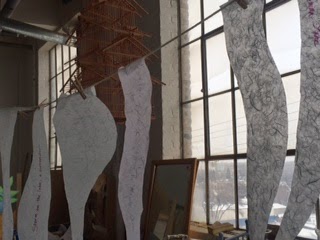
 The second half of our session took place in Susan Armington's studio where we viewed her work which is very much based on water, geography and culture. She asked what we saw in her paintings metaphorically and different imagery was noted, forms echoed by rivers snaking gracefully across her work. We then recalled experiences we had where water figured prominently. Our memories were ultimately captured on a clothesline of decorative papers where we noted the body of water and the metaphor it was associated with through our story.
Our exploration discovered that metaphor is a way to distill and explore meaning, to take a concept and broaden and enrich its usage through associations.


 Posted with Blogsy