Wednesday, February 24, 2016

The Many Sides of Wisdom

2/23/2016  by Susan Weinberg

Wisdom has often been personified by King Solomon, so much so that he was known as Solomon the Wise.  For our session this evening we took a closer look at Solomon throughout his life to identify the qualities of wisdom that were associated with him.   Meryll Page had prepared handouts that looked at different aspects of Solomon's wisdom and added a dose of imagination to give him voice.   You can find the handouts (Solomon the Wise - many views) that contain the passages that we referenced and a brief summary follows. We also identified the part of the body that governs each kind of wisdom, not always what one might expect.

A Rabbinic View
Rabbinic teaching credits Solomon with writing Song of Songs in his youth, Proverbs in middle age and Ecclesiastes towards the end of his life.  When given the choice by God to select what he wished, Solomon chose wisdom, knowing all else would then come. His choice is perhaps an evidence of wisdom even prior to his "God-given" gift. The mouth governs the rabbinic view.

Wisdom in Love
Song of Song and selections from Kings I present a wisdom that love is more than a physical act, it is poetry.  Solomon recognizes the power of words to women.  Of course he had a fair amount of practice with 700 wives and 300 concubines.  The intestines and liver (kishkes) govern love.

Wisdom Through Architecture and Construction
The passage on the building of the first temple presented a different kind of wisdom.  Solomon collaborated with others in the building of the temple and valued the wisdom of skilled workers in their creative work.  The hands govern the arts and architecture.

The Wisest of Kings
Excerpts from Kings I and Proverbs informed the passage on governing.  Solomon had requested of God a wise and discerning mind. He governed strategically and with foresight, relying on  alliances and collaborations.  He advocated for owning up to mistakes and noted that wisdom does not mean that one is perfect, more on this later.  Ruling is not relegated to one aspect of the body, in fact it required all of his awareness, morality and perhaps most importantly his fear of God that he notes as the beginning of knowledge.

Reflections of the Philosopher King
Ecclesiastes is the passage attributed to Solomon in his later years. His body was weakening, his mind still strong.   He was waxing philosophically realizing that the end was approaching, advocating for taking pleasure in the joys of living, eating bread and wine, finding happiness with the woman you love.  The heart is not the seat of love, but rather the seat of wisdom and hence the home for the philosopher.

A Shunned Prophet's View
This passage examines Solomon's behavior against the standards set in Deuteronomy 17:16-20 and finds him wanting. A good time to remind you that Solomon noted that Wisdom is not perfection, perhaps with good cause. The kidneys are the seat of our conscience.

While Solomon is granted wisdom by God, it is a gift to which he needs to be attentive. By the end of his life he has squandered it by losing his fear of God (1 Kings 11:1-12).  The Rabbinic view is that his wisdom grew as he aged, writing Ecclesiastes (the Koheleth) in his old age.  We like our heroes without clay feet so this may have been a bit of reputation management.  In his lifetime Solomon grew the kingdom and built the Temple, but he also lost the kingdom for his people ultimately by worshiping idols in his later years. 

The second part of our session was devoted to some design concepts led by MCAD professor Jan Jancourt.  One of our upcoming projects will be to work on posters around our exhibition.  In preparation for that Jan  presented basic design strategies and concepts.  He shared a variety of posters with us dating back to the 1800s where we could observe the different movements and occasional throwbacks.


Art Nouveau 1899
1849
Early examples challenged the eye.  All typography was justified with bands of information (steamship poster-above left)  The eye doesn't know where to go first. As graphic design became more sophisticated text was integrated into the artwork (above right).

Some design sensibilities were specific to a given industry and carried forward within that industry.  The introduction of photography began to change graphic design.  Often there was a technique known as outlining that removed the distracting background from an image to focus on the aspect to which the artist wished to direct your attention.
Saul Bass 1955

We talked at length about the Saul Bass poster on the Otto Preminger film, Anatomy of a Murder, where each body part is divided as well as the poster.

Jan noted that the term "concord" addresses what kinds of things look like other things, an echo of a concept in this poster and the opposite of contrast.

Polish - Tadeuz Trepkowski 1952
(Nie means wedge)
Polish designers were instrumental in conceptual design and metaphor after WWII. (above left) You can find more information on Polish posters at Polish poster art.

We discussed the use of illustration used by European designers after the war and Swiss typography, also known as international style, which was reflected in a 1964 poster right.  The concepts of less is more and form follows function are reflected in this simplified style.
Swiss -1964

San Francisco style
 The San Francisco style (left) is immediately recognizable through their use of color, image and type.

We also examined more current examples from Nike and Target to look at where design is heading. Jan reminded us that Gertrude Stein once said that anything truly new will be ugly.  Designers are creating for the future.

For the entire slide show click here.

While a whirlwind of information, the presentation captured the evolution over time of a number of  different styles including Classicism, Modernism and Minimalism.

Tuesday, February 9, 2016

Text as Texture

2/9/2016 by Susan Weinberg

Our session today was led by Hillel Smith, an LA based artist, currently in a show with Toni Dachis at The Tychman Shapiro Gallery that employs text in unusual ways. Our lab theme also built on the use of text, exploring how it adds texture and meaning to artwork. Smith uses text in art as part of the art itself. He raised the question of whether it needs to be legible in art and argued the case that when it is hard to read it forces the viewer to engage with it, to work to understand. Even when we are unable to draw meaning from the words they create texture. When it is illegible or in another language we respond to the rhythm and strokes.

Hillel shared a number of his pieces as well as those by other artists who make use of text. (see presentation) Among some of the projects that he shared was a joint effort with Itamar Palogue that used calligraphic brushstrokes that evoked Hebrew, but were not actually Hebrew.

The work that illustrates each artists' body of work actually melds together text and image often with text morphing into image (Slides 23, 24). The practice of melding text and image has a long history. It often made use of Arabic as illustrated by the Wazir Khan Mosque (slide 25) and is employed in early printed bibles (slide 26). Microcalligraphy has developed out of this tradition. It uses tiny Hebrew letters to form a design that may be representational, geometric or abstract.

Some artists who make use of text in their artwork include Keturah Davis (slide 28) who creates images out of text and Marian Bantjes (slide 32) who hides words within image. Michael Beirut (slide 30) took the approach of deconstruction by taking the Saks Fifth Avenue logo and deconstructing the text into a graphic now used on their shopping bags. While text is the medium, there are many ways that artists have worked with it, distorting, overlapping, repeating and deconstructing represent just a few.


We moved into a brief exercise where we were asked to use text in this manner. You can see some of the efforts below.


For the second part of our session Rosyle Ultan and Sharon Stillman presented a talk on the complementary topic of Wisdom in Word and Image. Rosyle shared text and poetry from the Kabbalah and other sources that she felt evoked wisdom. (See handout, Wisdom in Word and Image) Some thought provoking questions were proposed that examined the role wisdom played in the creative process. The small group discussions were introduced by this wonderful quote from Picasso.

“What do you think an artist is? An imbecile who only has eyes, if he is a painter, or ears if he is a musician, or a lyre in every chamber of his heart if he is a poet, or even, if he is a boxer, just his muscles? Far from it: at the same time he is also a political being, constantly aware of the heartbreaking, passionate, or delightful things that happen in the world, shaping himself completely in their image. How could it be possible to feel no interest in other people, and with a cool indifference to detach yourself from the very life which they bring to you so abundantly? No, painting is not done to decorate apartments. It is an instrument of war.”


Tuesday, January 26, 2016

The Intersection of Humor, Wisdom and Jewishness

January 26, 2016 by Susan Weinberg
Jewish humor permeates American culture. From the Marx Brothers to Woody Allen to Jon Stewart, Jews have left their mark on what we consider funny. Tonight we gathered in the Tychman Shapiro Gallery in the LOL show, a show devoted to humor. The theme of humor permeates the JCC with the presence of the Jewish Humor Fest through the end of January.
We took advantage of the wonderful material that quite literally surrounded us and focused upon the theme of humor and wisdom and its Jewish connections. Our task was to select an image and consider how humor, wisdom and Jewishness intersect.This is of necessity a visual exploration so let me share a few excerpts from the show and the responses they generated. Kate McDonough captured what many of us thought of as Jewish humor in her grouping of four cartoons.

We asked ourselves why we considered it humorous. Quite simply it made us laugh. We liked the contradictions in language in the one above and identified with the personality she depicted. The wisdom we found it in was self-awareness and a certain self-deprecating approach to that awareness.

We felt that the self-deprecating approach was very typical of Jewish humor. Humor is used as a defense against what we find challenging personally. And as Woody Allen frequently illustrates, worry and a touch of the neurotic are not alien to many of us. The drawing on the right captures that sense of otherness that many Jews carry within them.

Debra Fisher Goldstein's brightly colored photos of the Minnesota State Fair drew our attention with their interesting visual humor. They are real-time, feel-good, joyous images. While McDonough's artwork is personal and captures a sense of solitude, Goldstein's is social and focuses on an event we call the Great Minnesota Get-Together. How could we be any more social than that?

Here humor was captured by the incongruity of nuns munching on an ear of corn or the echo of the cone in the shape of the young man's hair. The wisdom is that of daily life and the artwork makes use of visual puns.

We were especially intrigued with the work by Toni Dachis composed of layered chunks of newspaper to spell out a familiar joke. There is a sense that something may be buried within. By reinventing the familiar in an unexpected way, she allows us to see it through fresh eyes. In fact we proposed that humor lives in the familiar. Too esoteric won't do, we need to recognize the familiar before we can appreciate the twist.
And what could be more Jewish than reading. We conjured up images of old grandfathers reading the newspaper.
Rochelle Woldorsky sketch

For the second part of our session we turned to text, The Wise Men of Chelm (see handout-The Wise Men of Chelm). For this you will need to take a minute and read the stories. The Wise Men of Chelm share the humor of the schlemiel. Laurel and Hardy grew out of this tradition. It is the trickster story where insight may be found from a non-conventional approach. Again we find self-deprecating humor. Even when the characters appear foolish they are treated with kindness and gentleness.We concluded that the wisdom is that there is always hope. The stories arose during a time when life was difficult and laughter was the way out, laughter that was shared as they all saw through the same glasses, an image captured by one of our artists.  (For more stories on the Wise Men of Chelm)

Tuesday, January 12, 2016

Fail Better


January 12, 2016 by Susan Weinberg
We began our session of the Artists' Lab with a discussion appropriate to this election season. Rabbi Davis posed the question "What do we look for in a leader?" Some of our responses reflected a reaction to what we see in today's public arena. A leader should embrace everyone, we replied. Being divisive is not leadership. Leading with one's ego is not leadership. Then we began to dig deeper and replied that a leader considers the big picture, bringing foresight and the ability to listen. They can break things down to decisions that are small but meaningful. They bring integrity. What we look for may vary a bit depending upon what they are to lead. A president or a spiritual leader may have somewhat different attributes, but many of the traits we noted are true of all effective leaders.

With that introduction we shifted to a handout (The Crown of...) with an excerpt from the Talmud that explores the idea of ranking. A very structured system of precedence was introduced. One of the more surprising aspects of it was a passage that noted a scholar or sage takes precedence over a king of Israel as he is less replaceable than a king. If a king of Israel dies, all of Israel is eligible for kingship, quite a radical concept. The Mishnah that follows this passage lays out some further ranking, but concludes with these words "If the mamzer (bastard) is a sage and the high priest is an ignoramus, the mamzer who is a sage supersedes the high priest who is an ignoramus."
R. Joseph Soloveitchik of Yeshiva University explains that our leader is not the king or warrior, but the Torah scholar, a teacher-king. It is a reminder that wisdom, not power guides the community.

We concluded this portion of our session with the idea that the crown of a good name is superior to the crown of Torah, priesthood or kingship. A good name is derived from our place within the larger community and underscores our responsibility to do good.
The second half of our session was led by your blog author Susan Weinberg and Rony Szliefer. Our focus was on failure and how it can lead to wisdom. We began with a little brainstorming. "What words do you associate with failure?" I asked.

"Mistake, anxiety, disappointing someone else," you replied. Several thought of failure in more factual terms - not meeting an objective in the allotted time, missing the mark. A few offered a more optimistic take with words such as opportunity and experimentation. "What do we call a person who fails?" I asked. "A loser" was the prompt reply offered in unison. You added that a loser is one who exhibits a lack of effort, is non-productive and self-doubting.

I then asked about the word success which interestingly elicited many more words associated with feelings - ambition, pride, surprise, elation, rewards and satisfaction. I began to wonder if it was harder to discuss the difficult feelings associated with failure than the pleasurable ones associated with success.

The word failure is derived from the Latin verb fallere and originally meant "deceive", but developed to mean to "deceive someone's hopes, disappoint someone".

The dictionary offers a rather depressing perspective on failure offering up such words as fiasco, debacle, catastrophe, disaster, flop, washout and snafu. No optimism there.

We shifted to a discussion of our experience with failure. I shared a personal story which you can find on my personal blog in the entry titled The Guise of Failure. There you will find my ruminations on this topic as I prepared for this session. Several attendees shared stories of failures including job failures, personal failures and artistic failures. All created feelings of dismay and uneasiness.The artistic failure involved cancelling a project when that inner muse failed to show up. Perhaps that is artistic integrity some suggested, not wanting to do less than your best. Is there such a thing as artistic failure? Not creating was suggested as an example. And yet artwork often has to emerge in its own time, the muse doesn't always show up on our schedule. Liba wisely suggested we need to think more about process than end result.

We then explored how religious texts address topics of failure and humility (handout). Hasidic wisdom says "Every descent is for the sake of a future ascent" and Solomon the Wise noted that "the Tzadik falls and stands seven times".

Within Proverbs there is quite a bit about not being "wise in one's own eyes", not being too full of oneself. Humility is closely associated with wisdom and the wise person learns from the "reproof of life" as expressed in Proverbs 15:31 "The ear that hearkeneth to the reproof of life abideth among the wise."

In more modern times Samuel Beckett echoed Solomon the Wise with "Ever tried. Ever failed. No matter. Try Again. Fail again. Fail better."

Some of our most innovative companies have a culture that embraces failure. This philosophy is at the core of many of 3M's successes from Post-it notes to Scotch tape. Often a failure for the initial objective proves to be a success for a problem yet to be identified. Now that's a culture of failing better.

Rony worked with us to explore our relationship to failure and how it can get in the way of wisdom. He noted that often a perceived failure is followed up with a resolution to never do that again, "that" being the source of our anxiety. We act out of fear of the discomfort associated with failure.
He asked a telling question, "How many welcome failure?" No one volunteered for the welcoming committee. Even those of us who speak of failure as an opportunity tend to shift to that mode when we are making the best of what we perceive as a bad deal, trying to find some meaning in a failure that arrived uninvited. Welcome it? I don't think so.

Rony asked about the experience of failure and now the feeling words emerged -sorrow, discontent, anxiety, embarrassment, shame, obsessiveness, emotional churning. Failure clearly affects us emotionally and discomforts us deeply.

He raised the question of when do we first experience those feelings and pointed out that young children do not have that fear of failure. Our fear of failure arises from the desire to not experience those feelings again.

In closing he pointed out that earlier in our sessions we talked about how wisdom is related to awe which is only possible in the presence of the unknown. Thus it is that our fear of failure often hampers our ability to explore the unknown and in fact limits our ability to embrace wisdom.


Wednesday, December 23, 2015

Upward Reaching

In response to my prior post on visualizing wisdom through artwork, I invited lab artists to share their thoughts on why they selected a particular image as representing wisdom.

Carolyn Light Bell shared her thoughts on why she selected the work of Milwaukee Artist Lab artist Berit Engen as expressing wisdom. The following work from left to right is Exile (By the River of Babylon), Yiddish Wisdom: If everyone pulled in the same direction, the whole world would fall down and Yiddish Wisdom: It is easier to guard a sack of fleas than a girl in love.
by Carolyn Light Bell

Berit Engen has depicted the upward reaching toward a greater energy. A supplication. Wisdom comes in knowing when and how to ask for help from powers greater than mine. The burning that comes from fire can be seen as both destruction and creation. Blueberries only grow from earth where fire has added nitrogen to the soil. In the same way, we bear new fruit from the death of our deeply-rooted hopes and dreams.

Ms. Engen’s work combines the elegance of Nordic design, which captures the order and simplicity of distilled natural beauty, with the movement and passion of Jewish experience, our constant striving toward God.

Her color and style are pleasing to the eye, capturing the insistent stretching up of all impulse. Her wisdom lies in knowing where to focus her talent—on what aspect of the human condition.


Rosyle Utan was particularly drawn to Barnett Newman's work and felt it expressed the concept of wisdom through challenging us to engage with the unknown. Below are her comments on her selection.

by Roslye Ultan

My response to making the selection of Barnett Newman, ONEMENT IV, 1953 (part of a series), for Art Lab discussion on the theme of wisdom – is/was indeed a formidable task. How does one begin to grasp in visual terms the ungraspable concept of wisdom? My first inclination was to go to the most expressive abstract works (Abstract Expressionism) of the Jewish painter/philosopher Barnett Newman—partly because our investigation is/was to search the annals of “Jewish” wisdom, and secondly because Newman did not try to offer an answer, but challenged us/the viewer to engage in a conversation with him/the art object in a vast spatial field unencumbered by any preconceived limitations. Rather, Newman offers/as well as seeks to understand the mystical inner workings of humankind through an ecstatic expanse of space into which he invites us to participate. I chose to go beyond what is known or seen into a more authentic source of primal inspiration – the awesome unknown/the place of doubt, of dreams, of myth which are conjured up when faced with a grand-field of intense blue divided by a white line (a Zip), me/you, struggling to find signs that might lead somewhere.


By Lynda Monik-Isenberg


I chose James Turrell's Skyspace in Austin Texas. It was an immediate reaction to the call Jay and I made for submissions. For me, James Turrell's artwork engages wisdom in intellectual, conceptual and emotional terms.  He 'provides' light the ephemeral substance that bring us life, that marks our days and actions, that allows us to 'see'; he isolates and focuses it and us - allowing his participants to consider light in its wholeness (color, shape, time, sustenance, insight...). The work is contemplative and quiet with meaning made by the participant. This piece reminds me  that wisdom is often simple, elegant, slow in coming and is born from interaction, reflection and quiet.

"My work is more about your seeing than it is about my seeing." --- James Turrell

Youtube video


Phil Rosenbloom contributed Rodin's Gates of Hell and offered these thoughts.   

by Phil Rosenbloom

I chose Rodin's Gates of Hell because it depicts Rodin's concept of the Artist's role in society.  In the middle towards the top sits "the thinker" and he looks down on the rest of humanity in the form of Rodin's interpretation of Dante's Inferno.  The artist's job is that of the thinker, looking, observing and thinking about the human condition.  


Image by Anabelle Dureau


By Ann Ginsburg Hofkin

I found this on the Internet.  It made me gasp a bit, since it is an image that portrays various elements, some of which may be difficult to define and impossible to contain. That is how I view the concept of wisdom...attempting an understanding of this is an enormous and exciting challenge.


Several offered Ted talks which elaborate to a much greater degree on the piece they selected.  Anita Konikoff who chose Crochet Coral Reef (right) provided the Ted talk below on her selection.  More images are available on this site.


And Paula Pergament offered this stunning Ted Talk by Jason deCaires Taylor which gives new meaning to wisdom as an interaction with nature and time.

Tuesday, December 22, 2015

Visualizing Wisdom

December 22, 2015 by Susan Weinberg Our session actually began a few days ago with an assignment. We were asked to send in an image of someone's artwork that represented wisdom. Not so simple. First we had to think about how we visualized wisdom, then find an image that represented it. If you are a believer in "I'll know it when I see it" you likely spent some time scanning the universe of artwork in search of wisdom.

I began my search in the figurative and symbolist world looking at artwork by William Blake and Gustav Moreau. Interesting work, but nothing that said wisdom to me. Then I thought back to a visit to the Minneapolis Institute of Arts that I went on last week. The visit was prompted by one of their book based tours on the book Rez Life that took me to the Native American galleries.

Ah ha! I knew which piece I wanted to share but had a dilemma. I didn't remember the artist. Thus began my search through mediums until I quite by accident stumbled upon my selection, a piece by Ernest Whiteman based on petroglyphs and embodying the heart-line, a red neon line running from throat to heart, a plumb line of sorts. Whiteman talks of the heart-line as a life force that takes one on a path or journey and provides the balance between what we are given by nature and what we take from the earth. The traditions speak to harmony between man, animal and nature. "Clearly a wisdom based piece" I thought.
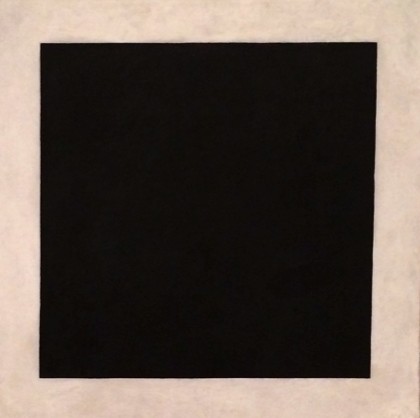
When we gathered this evening Lynda Monick-Isenberg and Jay Isenberg took us through a slide show of the images that had been submitted. They then broke the artwork into four groups, those that were more abstract, figurative, nature derived and other. We were asked to form groups according to our artwork. My selection was placed in the abstract group along with images of the Rothko chapel, Onement IV (blue rectangles) by Barnett Newman, Black Square by Malevich, Blue Nude by Matisse and tapestries on Exile and Yiddish Wisdom by Berit Engen.
We were asked to employ a process of critical response by identifying what we noticed, what it reminded us of, emotions it generated, questions it raised and the meaning or understanding that was conveyed by the work. For example for Matisse's Blue Nude we noted the ocean-like blue, a mood of contemplation and serenity and the negative space of the image. We were especially intrigued with Matisse's resilience in reinventing his approach in the face of physical limitations, certainly an element of wisdom. Rothko's work generated words such as radiance, reverence and enveloping and reminded us of eggs and shells. We were curious about the differences in creating work for a chapel rather than a museum.

Although all of the work we selected was composed of simplified forms, not all of it spoke to everyone in our group. The simplicity of the Malevich and the Barnett Newman eluded some of us in terms of meaning. Overall the gathering of work seemed to speak to both space and negative space.
We were then asked to move to another group of images, those of the natural world, and found that we struggled a bit. In our time discussing abstraction we all seemed to have turned into minimalists, finding the photographs less to our taste. The questions we asked included such queries as how do you convey grandeur without presenting it on a silver platter? How do you have wisdom without sounding trite? It is a delicate line to walk.

It occurred to me that perhaps our response was a function of the work we had originally selected and I wondered how those who selected the natural world images would respond to our more abstract choices.
When we considered the two groups our preference for minimalist and more abstract work was based on the idea that it allowed room for the viewer to enter. It was more subtle and asked the question, allowing room for contemplation and interpretation. Some of the natural world images illustrated the idea and were more familiar to us and hence we felt were less likely to engage the viewer to do some of the work. Our take-away was that we perceive wisdom in many different ways and perhaps have some innate preferences.

For the last portion of our session we were given a creative assignment, the forced connection. We were instructed to select our original image as well as one other that spoke to us. First we were to list the conceptual, emotional, intellectual, technical and design content of each work and then create new connections visually.
I was intrigued to discover that the work that I gravitated to outside of my own selection was that of James Turrell, a physical space at the University of Texas. Interestingly it echoed many of the themes of my original selection. Both made use of negative space through a cut out form and addressed concepts of duality, inside/outside, people/nature. Both presented a theme of balance and made use of circular forms as focal points. It was an exercise that made conscious some subconscious expressions.

We were then asked to create a visual representation that expressed new connections out of this process. Many chose to work with collage, often selecting Malevich's simple space to introduce another contrasting image. So often we struggle with how to express a somewhat abstract concept. This exercise not only identified imagery that we associate with wisdom, but allowed us to begin to recognize the themes that reside within our subconscious.
If you'd like to see the images we submitted please click here.

Tuesday, December 8, 2015

A Wisdom Stew

December 8, 2015  by Susan Weinberg

When I return from a lab, I often feel as if my task is to create a stew, so many different ingredients that somehow must blend into a whole.    My job is to cook them down into something that complements and blends into a savory mix, a wisdom stew.

Rabbi Davis began our discussion with a brief introduction to the Wisdom of Our Parents. 

Proverbs 1:8 My son, hear the instruction of your father, and forsake not the Torah of your mother.

What exactly does this mean? Rashi hazards a theory, understanding "the Torah of your mother" to mean the Nation of Israel and the sages' words who renewed and added to the Torah, creating fences.

Fences?  Our guest Jon Adams Ross offered a useful explanation of fences from acting parlance.  An instruction to act might cause one to freeze he noted whereas some acting prompts inspire action.  Fences allow freedom.  Boundaries define a playing field enabling us to act.

So are there different teachings from fathers than from mothers?   Some suggested fathers focused on the specifics, mothers applied it to the family.  Fathers addressed how to behave in the outside world, mothers understood the internal person and set the standards for how to interact with others.  Some saw it less as fathers and mothers, more as feminine and masculine energy.

Our attention shifted to our guest, Jon Adams Ross, also known as JAR.  Jon had joined us last spring as part of his work on a Covenant Foundation grant to create five new plays for five cities each inspired by a different patriarch or matriarch.  His way of working is through interaction with others.  Next week he will be doing a play on Abraham, later a play on Rebecca, then Jacob as part of the InHEIRitance project.  This is different than that book you may have inherited that stayed on your shelf, he noted.   His objective is to bring life to this inheritance.

"Let's talk about transmission," he said.  How does that happen in 2015?  How do we transmit wisdom without words?

He started us off with cave paintings.  Music was quickly added.  Food said another... kissing, crying, smiling, handshakes, dancing, eye contact, posture, image, all were added to our list.

He then moved us into an exercise with the assistance of David Sherman.  He whispered a brief instruction into David's ear and David walked briskly across the room.   What did he just do he asked?  This exercise was repeated with David looking over his shoulder and running, checking his watch, screaming and running away.  


Jon made the point that with transmission without words we can't control the story.  We as the actor or artist may have one idea, but it gets filtered through the experiences of the viewer.  They may see something else entirely.  He put this to the test with an exercise where we were to think of something we would want to pass on to the next generation. 

For me that something is family history as my Jewish family is rapidly diminishing.  As the family historian I hope to share that history with nieces and cousins who have some interest in our Jewish heritage.  Now we were asked to draw something that represents that.  I had already done a series of paintings on family history, one that included my grandmother blessing the candles, an image that was filtered through my mother's memory in its creation.  I quickly sketched this image.  We then traded our images to others who wrote what it said to them.  Keeping tradition, routine, consistency was the perception through someone else's eyes.  I chuckled. Totally foreign concepts in my family. I'd be happy with simple awareness.

As we went round the room to determine how each interpreted each other's drawings, a theme of connection was repeated again and again.

We are beginning our artist led sessions and the balance of the session was led first by Jonathan Gross and later by David Sherman. Jonathan’s focus was on the intuitive nature of wisdom, the origin of both hakima (wisdom) and yira (fear/awe).  He started us off with this quote from Albert Einstein.


Where the world ceases to be the scene of our personal hopes and wishes, where we face it as free beings admiring, asking, and observing, there we enter the realm of Art and Science. If what is seen and experienced is portrayed in the language of logic, we are engaged in science. If it is communicated through forms whose connections are not accessible to the conscious mind, but are recognized intuitively as meaningful, then we are engaged in art. Common to both is the loving devotion to that which transcends personal concerns and volition. 

Jonathan’s premise was that if wisdom is an adaptive characteristic it will persist.  His perspective was through evolutionary psychology and examined the complex mix of innate and learned behaviors that make up human behavior.  One aspect of the brain on which he focused was the temporal lobe that has the ability to infer intentionality.  Remember that viewer who may come up with a different scenario than was intended?  That’s the temporal lobe at work trying to decipher intention.  This is the part of our brain that comes up with both conspiracy theories and religious experiences.  And it is a touchy creature.  The cost of a false positive, detecting intention where none is meant is low, whereas the failure to detect intention could be much more serious.

One of the questions Jonathan posed was whether hakma (wisdom) was the effect of natural selection?  Judaism has survived through much of history without a common territory.  Has wisdom been essential to that survival?  If so, has it developed as a trait through natural selection? Did a tradition that valued wisdom, harbored within our religion, enhance the survival of those who employed it?  As an example of this wisdom, Jonathan referenced Solomon’s Wisdom, the recognition that ensuring survival of our offspring is a fundamental adaptive behavior.  (click here for a copy of his presentation on the Intuitive Nature of Wisdom).


David then spoke with us about Artistic Wisdom and posed three sentences for us to finish.


Artistic wisdom is….


My last moment of artistic inspiration was …


My last moment of artistic self-doubt was….


Just as the viewer who gets to impute their own perspective, the blog writer gets to do likewise.  So here were my responses….


Artistic wisdom is telling a story that reveals deeper truths and understanding.


My last moment of artistic inspiration was when I reached into my pocket on the way here and felt my mother’s glove.  Now I realize that takes a little more explanation.  As I was tackling the home of my late mother I ran across some fur lined leather gloves we had gotten in Italy years ago.  I took those gloves, molded to her hands and stuck them in my pockets. Now I discovered them once again and thought about how putting my hand in the glove was like holding her hand.  Which then took me into a mental riff on things and the presence they hold of another person. Perhaps that will show up in a blog or painting.


And my last moment of artistic self-doubt was yesterday as I re-read a writing project and debated if I could take it to the next stage.

So quite a savory stew of parents, fences and temporal lobes all blended richly into the wisdom encoded in our DNA and expressed creatively even in the face of doubt.

 
 Happy Hanukkah!