Wednesday, October 28, 2015

In Search of Hakhma

by Susan Weinberg 10/27/2015

"Echoes: Voices of Wisdom" is our theme this year, one that we haven't yet absorbed in its entirety, still struggling to recall it. We often resort to our short-hand version of "wisdom", yet "echoes" and "voices" frame it up and hint at where we find it.

In our last session we referenced the Pirkei Avot, Ethics of the Fathers, which states, Who is wise? The one who learns from every person…(Talmud - Avot 4:1)

With that in mind we turned to text and the voices that use the term "wisdom", looking for context to determine its meaning. The Hebrew word for Wisdom is "Hakhma" (pronounced Hokma). I learned that quite recently during the retreat as I examined the stained glass windows in the former synagogue where we attended a concert. The creator of the "wisdom" window used the Torah to represent wisdom with the word below it. We too turned to Torah seeking the meaning of wisdom.

Meryll informed us that the wisdom books of the Tanach are the books of Job, Kohelet (Ecclesiastes) and Proverbs. I did a search for the word "wisdom" in the Hebrew Bible and found that these three books do indeed account for 50% of it.

We began our exploration identifying synonyms for wisdom. Some of us offered words, others sentences and concepts. Among them was the concept as discussed in the Indian culture of the ability to think and act where common sense prevails and choices are beneficial and productive. Another approach was in terms of a hierarchy of information with data at the bottom, then knowledge which is applied data, then wisdom which is the application of knowledge to achieve a desired result. These were very results oriented forms of wisdom, focused on action.

A more text focused definition was offered from the first bracha of the Amidah which says "You graciously bestow knowledge upon man and teach mortals understanding. Graciously bestow upon us from You, wisdom, understanding and knowledge. Blessed are You Lord, who graciously bestows knowledge."

And then we offered a flood of words: truth, insight, perception, openness, knowledge, understanding, questioning, justice, judgment, integrative and action or doing.

With that grounding we began to examine passages from the Tanakh and Rabbinic literature. The first mention of wisdom in the Tanakh is in Genesis 41:33 where Pharaoh seeks a man of discernment and "hakhma", ultimately finding Joseph to make sense of his dreams and act as a problem solver and manager.

The next time hakhma is mentioned is in Exodus 31:1-6 where God speaks to Moses about a craftsman who he has endowed with a divine spirit of hakhma, ability and knowledge. We noted that wisdom was distinct from ability and knowledge as those qualities were noted separately and secondly that God was the giver of hakhma. Wisdom is associated with craftsmanship of precious metals, quite a change from the prior role of the Israelites as hard laborers, "shlepping" stone to build pyramids. In this post-slavery world the first people endowed with hakhma are artists. The same passage goes on to speak of hakmat lev, a wise heart, but in this context they are granted hakhma in order to follow commands, not an association we are prone to in today's world. As artists we may want to think in terms of hahkmat-yad, wisdom of the hands.

What do our sages say about wisdom? Rashi notes that hakhma is what a person learns from others. Associated words are T'vunah which is a wider understanding gained through intelligent application of what one learned, also known as ability. Finally there is Da'at, knowledge.

We were then asked to examine a passage in I Kings 2:9 where King David speaks to his son Solomon shortly before David's death. He is briefing him on who he needs to watch out for and to use his wisdom on how to deal with an objectionable person even as he urges him to deal with him rather aggressively. Finally we turned to the Haggadah's wise child who is referred to as wise due to his challenging and questioning tone.
The second half of our session was devoted to mind mapping applied to wisdom. With colored pencils and markers at our side we began free associating, capturing words associated with wisdom in a variety of formats. Many reflected the fluid and evolving nature of wisdom, egg shaped ovals, leaves and water. In our small group we determined that wisdom is relational and must be shared and touch others. We absorb it and also find it through carving, cutting away what is non-essential to shape it much as a sculptor. It is not just judgment, but must be tempered with feeling, kindness and giving in order to find our heart of wisdom.

Monday, October 26, 2015

Di,di,di,di

Over sixty artists from five cities gathered in Milwaukee for the third Artists' Lab retreat. Music was central to this retreat with Joey Weisenberg leading the way, charming us with a joyful smile into participating in nigguns, drawing us closer until we clustered around him and song filled the room. Di, di, di, di we sang, our voices moving up and down with the melody. While the niggun, a wordless melody, is rooted in Hassidic tradition, Joey brings it to different arms of Judaism. Music proved to be the armature on which this retreat was built with our Shabbat services as well as other events enriched by Joey's melodic voice and welcoming manner.

So what else was this retreat? Certainly an expansion of our community. We had many opportunities to interact with our fellow artists, welcoming familiar faces and quickly forming connections with new ones. We started out by gathering close to the familiar people from our own lab, but we quickly broke out of our comfort zone in a session with Helene Fischman. Fischman did a series of exercises that married image and text as well as collaboration within our artist lab community. She moved us from words to image as we developed a visual response to each other's words. Finally we were asked to write of a moment when we felt pleasure in our creativity. We shared our narrative with another participant who was called upon to draw what we described. As I began to build a relationship with a new member from Kansas City I could feel the walls between our individual labs crumbling.

Our retreat was also an opportunity to interact with the city. We walked through the city to our lunch and then along the water to the Milwaukee Art Museum, located next to the water and very appropriately resembling a ship. When it is open the wings lift on either side. You need to wait for specific times to witness this unless you are Mick Jagger, who we were told got a special performance of the wings. While most of the museum was closed for renovation and the addition of a new wing, we were able to explore the Larry Sultan photography exhibition and have a behind the scene's tour of the work in progress.


It had a rather otherworldly feel to see artwork shrouded in wrappings, just hinting at what lay beneath, quite Christo-like with everything becoming a new kind of artwork seen through fresh eyes.While most of the artwork has to be protected from the light, the sculpture gallery is visually extended by the magnificent expanse of water just outside its windows.


After our tour of the museum we gathered for Havdalah, led again by Joey as Robyn held the havdalah candle aloft. As Joey invited us to gather close he told the story of a miracle in the temple where even though everyone was so close, when they bowed down they didn't bump into each other.
We concluded our day with yet more music, music of the Yiddish Theater. The performance was in the Zelaso Center which was once the synagogue for Emanu-El and still had the bones of its legacy with stained glass windows illustrating Jewish themes with a bit of an American twist. Freedom was illustrated by a bell. Wisdom, our theme for this year was of course illustrated by the Torah. As it was night, we had to look closely for the imagery.
Miryem-Khaye Siegel
Wisdom


The performance space was the perfect size, small enough to actually feel the music. It was an extraordinary event with three female vocalists who were each musically talented and had an excellent comedic sense which lent itself to many of the Yiddish songs. David Jordan Harris was kwelling a bit as the talented Miryem-Khaye Seigel had been his student.
Joanne Borts

We ended the day late at night and groaned a bit at the early start time for the following day. In an interesting juxtaposition we were taken to the new Emanu-El B'ne Jeshurun campus, the same synagogue that was once housed where we heard the evening Klezmer performance. Our groans were quickly forgotten when we entered the space.

Breathtaking and spiritual best describe it. The first thing you notice is that there are no stained glass windows. Instead large vertical windows slice the walls surrounded by images created by Tobi Kahn. Through the windows trees draw your gaze upward. The overall effect is rather Zen-like.

It was a wonderful illustration of what can be accomplished when you incorporate the arts and represented the work of a number of those in the Milwaukee lab. Philip Katz of the Milwaukee lab designed the sanctuary and shared some of the elements with us. He actually grew up down the street from the old synagogue and his study of synagogue design led into his work with this project. He described the space as a blend of opposites, solid and void.

Nina Edelman did the richly colored Torah covers and the cover for the ark. Barbara Kohl-Spiro played an important role in making it happen.

The landscaping was also an important part of the facility as it functions in lieu of stained glass.

At the entrance to the building lies a sculpture by Richard Edelman. It is a shofar shaped of cubes. Before we left the facility we listened to Tekiah Gedolah blown on a traditional shofar magnified by the large sculpture.


Our sessions concluded at the JCC where we did some small group discussions, had an opportunity to see the lab show of the Milwaukee artists and to share our work with each other. Overall we gave the retreat an emphatic thumbs up and would encourage others to attend the next retreat. The takeaway was certainly a sense of greater connection with the entire lab of artists and a newfound appreciation for the city of Milwaukee.

Tuesday, October 13, 2015

A Heart of Wisdom

 October 13, 2015  by Susan Weinberg

We joined together today in a new beginning in the Artists' Lab. For some of us it is the fourth year  of a growing community of artists.  We fondly greeted familiar faces and were introduced to new ones.  We had a much larger group as we brought the two labs together and added new members.

We gathered with our facilitators in an introduction to our topic of Echoes: Voices of Wisdom, a rich topic with much to explore.  Meryll began our exploration by introducing the Pirkei Avot, Ethics of the Fathers, a section of the Midrash written around the Common Era.

 It states Who is wise? The one who learns from every person…(Talmud - Avot 4:1)   She noted that the word for teacher and student comes from the same root, for hopefully we are both.

Rabbi Davis then introduced a parable from a book titled The Hasidic Parable by Aryeh Wineman.  The parable entitled Or HaEmet  tells the tale of a king who created a challenge with incentives to test the diligence of his servants.  Three groups of servants attempt three strategies with only the final one achieving the goal. Take a minute to read it before you proceed.

We had an energetic discussion about the need to seek wisdom by coming in unencumbered by emotional or physical coverings, without artificial light and in concert with other souls.  It was noted that the parable rewarded those who exhibited both planning and forethought as well as being willing to respond to circumstances creatively and in the moment.   Others noted traits of resourcefulness and faith.  We also assumed that the later servants learned from the failures of the earlier servants.  As this was a metaphor we looked to the meaning of different elements.  We concluded that illumination through precious stones represented seeking deeper knowledge.  Illumination was only found by being willing to destroy what we know.

Many were uncomfortable with the role of the king, particularly the element of judgment and condemnation of failure.  When asked how we would apply this to our experience in the lab we spoke of the need to be vulnerable, but also to create an environment of trust, rather than competition.  We felt it important to be able to risk failure in a nonjudgmental environment.  The king had no place at our table.

Some spoke of their experience as a parent or as an immigrant to a new country as a time when they had to be vulnerable to achieve a greater level of wisdom.

The second part of our session was both an introduction of members and a sharing of something we associated with creativity. We hadn't much time to consider this question and several of us confessed to groaning at the receipt of this last minute assignment.   It proved; however, to be a very intriguing project with thoughtful responses from all.  Lab members offered up music, poetry, readings, Jewish parables and quotes.

Some of the offerings included the poems Remember Me by Hal Sirowitz and Otherwise by Jane Kenyon and the wonderful quote "Seek the company of those who search for truth; run from those who have found it." (AndrĂ© Gide).  In the realm of great minds think alike we had more than one person who brought their Tibetan singing bowl or a seashell.  The Tibetan bowls "spoke" for themselves.  The seashells were symbolic of wisdom with the hardness on the outside that represented the accumulation of experience with the inside luminous and if fortunate containing a pearl.

Some of us offered linkages to the past, a cookbook offered as a tender gift from a father and for me, a folder of notes on books read from my mother.  While some in our group sought ideas from the Internet, for me wisdom has always been associated with my mother who recently passed away. In her files I found a wonderful folder of excerpts from books that spoke to her and reminded me of our many conversations about books and life.  When Meryll had spoken of the Pirkei Avot, I had flipped through my mother's file sure I had read of it in there.  Sure enough she had a page devoted to it.  I shared some of the quotes in her folder such as "Don't try to make life a mathematics problem with yourself in the center and everything coming out equal" or "we are our injuries, as much as we are our successes." (The Poisonwood Bible by Barbara Kingsolver).  Or the rather biblical sounding quote from Nicole Mones in Lost in Translation, "A brave man bows to circumstances as grass does before the wind". She also wrote of a book by Jerome Groopman titled The Measure of Our Days: A Spiritual Exploration of Illness.  Within it he had referenced the Biblical Psalm 90, a psalm of life and death which presents a perspective on wisdom.

The stream of human life is like a dream,
In the morning, it is as grass, sprouting fresh,
In the morning it blossoms and flourishes,
but by evening it is cut down and withers
Our years come to an end like a fleeting whisper.
The days of our years may total seventy,
if we are exceptionally strong, perhaps eighty;
but all their pride and glory is toil and falsehood
and, severed quickly, we fly away...
So teach us to number our days that
we may attain a heart of wisdom.


Friday, August 28, 2015

Flowing In, Flowing Out

Joint Lab -August 27, 2015 by Susan Weinberg
Last night was closing day for the third Artists' Lab exhibition. We gathered in the gallery and each of us shared with our fellow artists the process behind our work.
I always feel like an apology is necessary when I attempt a recap as I can't capture all of the artists' work in the space of a blog post, particularly as the number of artists grows. I shall leave it to the catalog to do that. With apologies to those I missed, here is but a sampling to reflect the efforts of the year 3 lab artists.

Outside of the gallery we were greeted with three images. Ann Ginsburgh Hofkin shared her photograph of a wave on aluminum. Frozen in the moment, it evokes that moment when the Red Sea parted for the Israelites.

Next to it Jonathan Gross presented us with a highly detailed panoramic image of the river. It was so rich with story that I found myself imagining using it in a classroom as the impetus for students to construct narratives. On the far left he captured a group of kayakers, a serendipitous event that his process allowed him to replace within the panorama. On his right you can see a painting by Sandra Felemovicius that seeks to capture reflections within the water.

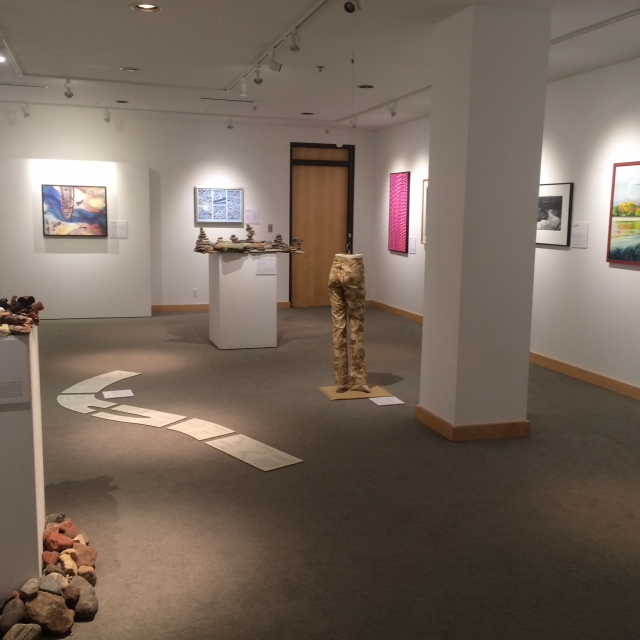
That was our warm-up. Now we entered the gallery. One of the things that I especially liked about this show were the interactions between artwork. Often it seemed to me that they were having conversations. Let's listen in...

Joel Carter's rock sculpture seemed to be working the room, creating interesting vantage points in relation to other works. Joel realized that his well-polished river rocks that he uses in his carefully balanced sculptures come from... water! 

 Below (left) you can see his work chatting up Rani Halpern's layered, dyed and cut image that is based on a midrash of God dividing the waters into sky and ocean. When those below protested their perceived lower status, God took his finger and tore the waters apart. The warm colors of the rocks also frame Susan Armington's Waters of Babylon (right). the land of exile for the Jews and the modern day Iraq.

Near Susan's work you can see Sylvia Horwitz's amazingly Biblical photograph of a tumultuous sky over still waters, the firmament in-between.
Alison Morse's words trace the form of an Italian river on the floor below, even as they tell the tale of an Italian Jew. But it does more than that, it guides us in and out of the gallery, directing us along the river to the artwork that surrounds it.

Susan Weinberg's diptych on water and memory conversed with Bonnie Heller's reminder of the two worlds between which we can choose. Several people jotted memories that they had shared with those who lost memory for the memory jar that sits before the paintings.


The shape and concept of the tear or raindrop was echoed in both Leah Golberstein's sculpture of stones and salt, Liba Zweigbaum Herman's water ketubah and Rani Halpern's chain of rain drops. Leah's work is based on a midrash about how God offered Adam and Eve the "tear" as a release and solace upon their exit from Eden. Liba invites each of us to pledge our commitment to managing our water resources, all framed in the form of a ketubah, a contract with our guest of honor - water.

Many of the artists talked of how the lab had encouraged them to try new mediums or approaches. Rani spoke of how the layered approaches in her work were new to her since the lab. Notice above how the shadows on the wall in her work add yet another layer to her multi-layered work. Sylvia referenced her more typical work of documentary photos versus the work she has produced in the lab. There have also been some collaborations. Sylvia Horwitz and Susan Armington collaborated on a show this year while Louise Ribnick and Diane Pecoraro collaborated on their lab exhibit - artwork and a prose poem around the theme of seltzer (below).


The approaches were unique and varied and most certainly creative. Jodi Rosen (above right) laminated text and placed it in water, then stirred it as she photographed it. 

Judy Snitzer (left) combined paint, collage, wood and text describing our relationship to water from Eden forward. And like several of us she built upwards. The more artists we have the less horizontal space is available and so we build our skyscrapers of art.

And as I can't capture everyone's work, here are some quick views of the gallery before we sadly dismantled it.
Finally that bittersweet moment when we removed our work from the gallery arrived.


Thursday, June 25, 2015

Ending on High Tides


Joint Lab 6/23/15 by Robyn Awend
Water has been our source of inspiration for the past year. It has quenched our thirst for knowledge, satiated personal and artistic growth, and created fluid connections with others.

Tuesday was our last Lab of the season. We gathered in our large group of nearly 30 and began with a nigun (song) about water, as we often do.  Rabbi Davis introduced Proverb 27:19: “As in water the face to the face, so the heart of man to the man.” We analyzed the Hebrew and English versions, discussing what this could mean. The group responded, “Water takes the shape of its vessel, as does the heart.” “Water is the connecting link to all things, as the heart connects us to one another.” “We can see our self in water's reflection, as we can reflect love onto our self.”For further discussion, Rabbi Davis & Meryll went on to share several thoughts from various sources about its meaning (from King James, JPS, A. Bible, ISV, etc.).

He then raised the question, “How does your artwork reflect who you are?” It was silent for a while as contemplation set i. Slowly, we went around and shared our thoughts –for some it was about our personal work serving as a direct reflection of who we are…..or the essence of the individual….or a product of where we are and where we want to be.

The follow up question was raised, “Has your experience with the Lab allowed you to connect with another person in the Lab in a significant way?” Two people sitting next to each other immediately hugged, two others caught eyes and smiled, and another raised her hand and shared about her connection to community.

We were then invited to stand together in silence. We were guided to flow like water, and at the sound of the bell, stopping and facing the person next to us while exchanging a moment of silence, together.  This lasted several rounds, there were hugs exchanged, smiles shared and even tears shed. We then gathered hands and danced and sang shuv-tey-mayim.
After a short break Liba and Yoni introduced us to a collaborative initiative that each of us would contribute to –a water symphony.  Juxtaposed to our recent exercise in silence, we now gathered around a series of tables to create sounds with interesting vessels filled with water (wine glasses, tubs, containers, etc.) and a slew of sound making gadgets (bath toys, sponges, straws, ladles, etc.).  We were each asked to choose one gadget and one vessel with which to create a sound. In complete silence, one by one, we began to create our individual water sounds, adding to the collaborative symphony.  As Liba tapped our shoulders, it was our turn to stop and just listen as the symphony faded to one last sound of water being squeeze from a sponge into a large pan. Yoni recorded this symphony, along with everyone else who had a recording device. We were exhilarated to be part of this two+ minutes of art in the making. Click here to hear our result.

The last exercise of the day was to create and record a unique breath, different than the person before you. We went around in a circle and shared our breath, some calm, others rapid, a few mysterious….

We closed the Lab by offering any last comments or shared thoughts. The room was overflowing with gratitude and a feeling of completeness.


Wednesday, June 17, 2015

Into the Mikvah's Waters

6/16/2015. Lab 2.0 by Paula Pergament

Lab 2.0 came to a close at Paula Pergament's lakeside home, a fitting conclusion for our theme of water.

Water and stone.

We each took one hand-sized rock from a pile of rocks Joel Carter contributed...We sat on the dock right over the water...contemplating thoughts ...holding our chosen stone.

Joel shared a poem about water.
The rest of us spoke a thought,
a word, a wish, a dream,
a trouble, a pain...
and each of us gave our words and stones 'into the mikvah's water'...

Rani's father's yahrzeit was last night and she chose to honor his memory by placing a stone gently into the lake...

Diane passionately shouted & with gleeful energy threw her rock far into the water.

It began to rain, so we headed inside to finish our lab inside at the kitchen table.  Wrapping rocks with beautiful Japanese rice papers, that represented water in color or by design, & twine.

Chatting about previous art labs, ideas for next year's lab, & eating 'water'melon, pecan'sandies' and chocolate ( not water related ...
but necessary).

A casual ambiance sat gently at the table with us.